
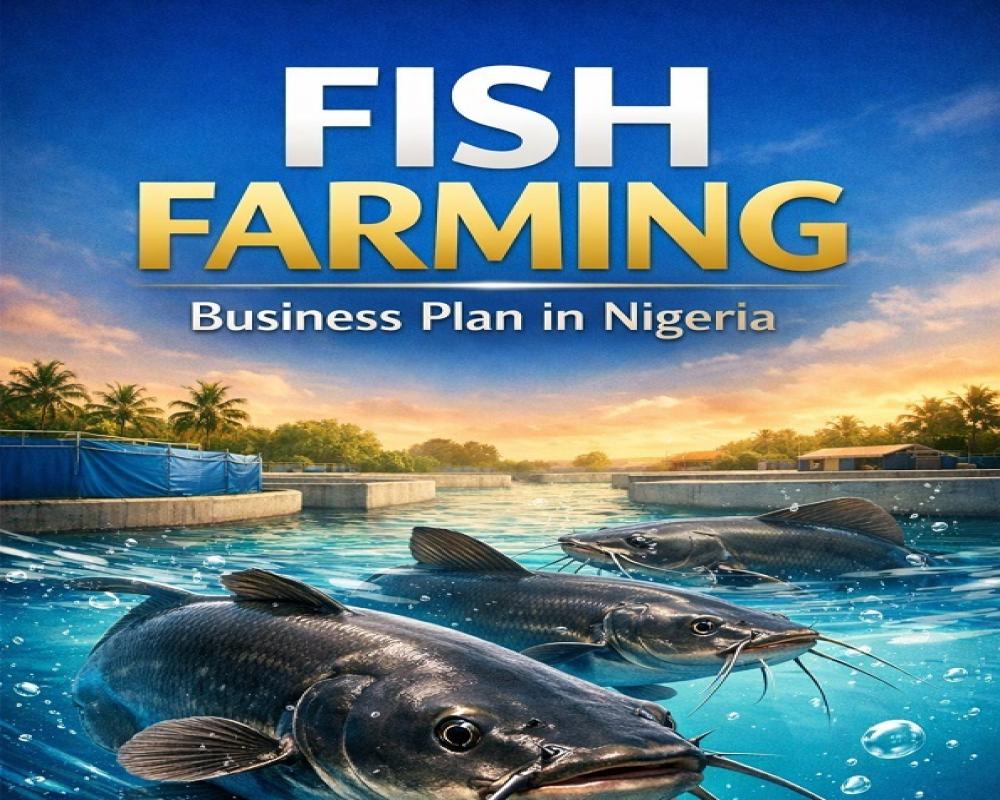
Fish Farming Business Plan in Nigeria 2026 (Complete 100 Pages)
This fish farming business plan provides a practical and realistic roadmap for establishing a profitable aquaculture venture in Nigeria. It carefully considers current economic conditions, including rising feed costs, power challenges, and market demand, offering conservative financial projections, operational strategies, and risk management approaches suitable for investors, banks, and agricultural funding institutions.
EXECUTIVE SUMMARY
Business Concept
Greenwater Aquaculture Farms Ltd is a proposed commercial fish farming enterprise focused on the sustainable production of catfish (Clarias gariepinus) and tilapia (Oreochromis niloticus) for the Nigerian market. The farm will be established in Ogun State, Nigeria, strategically located to serve the Lagos metropolitan area and surrounding markets.
The business will operate as a registered limited liability company under the Corporate Affairs Commission (CAC), owned by experienced entrepreneurs with backgrounds in agriculture and business management.
Location and Ownership
- Proposed Location: Mowe-Ibafo axis, Ogun State (approximately 30km from Lagos)
- Land Size: 2 hectares (initial phase)
- Ownership Structure: Limited Liability Company with three founding directors holding equal shares
- Legal Status: To be registered with CAC
Mission Statement
To produce high-quality, affordable fish protein for Nigerian consumers while creating sustainable employment and contributing to food security through responsible aquaculture practices.
Vision Statement
To become a leading aquaculture enterprise in Southwest Nigeria within five years, known for consistent quality, reliable supply, and ethical business practices.
Conservative Financial Highlights
Year 1 Projections:
- Revenue: ₦21,600,000
- Operating Expenses: ₦18,450,000
- Net Profit: ₦3,150,000
- Profit Margin: 14.6%
Year 2 Projections:
- Revenue: ₦34,200,000
- Operating Expenses: ₦28,800,000
- Net Profit: ₦5,400,000
- Profit Margin: 15.8%
Year 3 Projections:
- Revenue: ₦36,900,000
- Operating Expenses: ₦30,100,000
- Net Profit: ₦6,800,000
- Profit Margin: 18.4%
Break-even Point: Expected in Month 8 of operations
Return on Investment (ROI): 19.9% annually (conservative estimate)
Payback Period: Approximately 2.8 years
These projections are based on conservative assumptions including 10% mortality rate, current market prices, and realistic feed conversion ratios. All figures account for Nigeria's current economic challenges including high feed costs, power supply issues, and market volatility.
1. BUSINESS DESCRIPTION
1.1 Overview of Nigeria's Fish Farming Industry
Nigeria has Africa's largest aquaculture industry, with fish farming contributing significantly to the agricultural sector. Despite this growth, Nigeria still faces a substantial fish supply deficit:
- Annual fish demand: Approximately 3.6 million metric tonnes
- Local production: Approximately 1.2 million metric tonnes
- Import dependence: Nigeria imports over ₦150 billion worth of frozen fish annually
- Supply gap: Over 2 million metric tonnes annually
This deficit presents a significant opportunity for domestic fish farmers. The industry is characterized by:
- Growing middle class: Increasing purchasing power in urban areas despite economic challenges
- Protein preference shift: Fish is more affordable than beef and chicken, driving demand
- Government support: Various federal and state programs supporting aquaculture development
- Market fragmentation: Industry dominated by small and medium-scale farmers (85%), creating opportunities for organized commercial operations
Current Industry Challenges:
- High cost of fish feed (representing 60-70% of production costs)
- Erratic power supply necessitating backup generators
- Limited access to quality fingerlings in some regions
- Price volatility due to seasonal demand fluctuations
Rising operational costs due to inflation and exchange rate pressures.
0 Comments